
Teambuilding: Five tips to turn your group into a close-knit team
View article 
Written by: Arouna Fehou
Account Manager Team Masters
Sales complains that Operations isn’t moving fast enough. Operations feels that Sales makes promises without consulting them. Marketing doesn’t understand why IT is making things difficult again. And IT wonders why they’re always the last to be involved.
Sound familiar? As organisations grow, specialisation develops almost naturally. Teams take on their own responsibilities, expertise, processes and objectives. And that’s essential for working efficiently.
But specialisation also comes with a risk: departments can gradually become isolated silos. People develop their own language, focus on their own priorities and sometimes lose sight of what colleagues before or after them in the process actually need.
The result isn’t necessarily open conflict. More often, it’s the small, everyday frustrations: information shared too late, incorrect assumptions, duplicated work, defensive emails, frustration over handovers and a growing sense of “us” versus “them”. And that’s exactly where collaboration starts to become difficult.
A silo mentality develops when teams or departments primarily operate according to their own objectives, processes and information, without sufficiently connecting with other parts of the organisation.
It can manifest itself in several ways:
The problem isn’t specialisation itself. A strong organisation needs different areas of expertise. The challenge arises when those areas aren’t sufficiently connected.
Processes can be perfectly mapped out, yet collaboration can still break down. Why? Because collaboration between departments ultimately comes down to collaboration between people. When colleagues barely know each other, mistrust can develop more easily. A short email gets misinterpreted. A delay is seen as unwillingness to cooperate. A question feels like criticism. And people start filling in missing information with their own assumptions.
When colleagues know each other and have previously worked together in a positive way, they’re more likely to pick up the phone, ask follow-up questions or consider another person’s perspective.
How can strategic team building help break down silos?
A dinner or informal get-together can improve relationships. But when the specific goal is to strengthen communication and collaborationbetween departments, something more is needed.
A well-designed team building experience deliberately puts people in situations where they need to share information, depend on one another and work towards a common result.
This creates a temporary learning environment in which existing patterns become visible.
In everyday work, departments often have different KPIs: Sales wants speed, Operations focuses on feasibility, Finance monitors costs, Marketing aims for impact and IT prioritises security and continuity. None of these priorities is wrong. The problem arises when people focus exclusively on optimising their own objectives.
During a collaborative teambuilding activity, the final challenge is deliberately designed so that no team can succeed independently. The message becomes tangible: your part can be perfect, but if it doesn’t connect with the work of others, the overall result will fail.
Many teams believe they communicate clearly. Until they’re given a joint challenge that requires information to be passed on accurately. That’s when it becomes clear how quickly people make assumptions, ask too few questions, use too much technical jargon or rely on information others don’t have.
A well-designed team challenge reveals these patterns without singling anyone out.
When different departments work together, everyone sees a different part of the bigger picture. What feels urgent to Sales may seem unrealistic to Operations. What makes perfect sense to IT may sound incomprehensible to Marketing.
Teambuilding allows participants to experience first-hand how difficult collaboration becomes when everyone only has part of the information.
During an informal team experience, departmental labels temporarily fade into the background. “That difficult colleague from IT” suddenly turns out to have a great sense of humour. An account manager discovers that someone from Finance is incredibly creative. A manager recognises talent in a colleague they normally barely interact with.
These human connections may seem small, but they can make a noticeable difference to collaboration afterwards. The barrier to making a quick call, asking a question or solving a problem together becomes much lower.

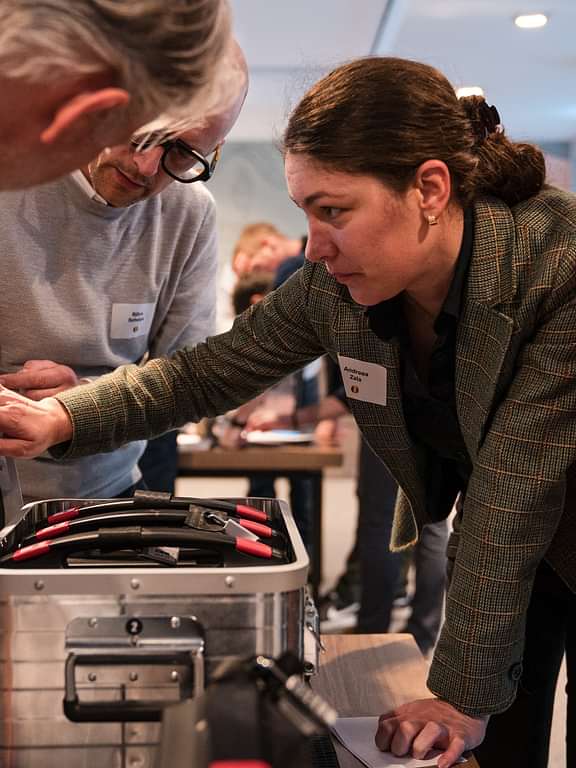
When the goal is to improve collaboration between departments, activities in which teams depend on one another are particularly effective.
During Chain Reaction, different teams each build one section of a large chain reaction. Every team can design, test and optimise its own creation. But ultimately, only one thing matters: does their section connect perfectly with the sections before and after it? This means teams constantly need to look beyond their own boundaries. How will our construction be activated? What does the next team need from us? When should we coordinate? Who is responsible for the transition between the different sections?
This makes Chain Reaction a particularly powerful metaphor for organisations. In the workplace, too, a department can have an excellent internal process. But when the handover to another department doesn’t work, the entire chain comes to a halt.
Why is it relevant for cross-departmental collaboration?
Because participants experience first-hand that optimising individual parts doesn’t automatically lead to a successful collective result.
During The Infinite Loop, not everyone has access to the same information. One participant enters a digital environment through virtual reality. The other team members have the information needed to guide that person through it. Nobody can solve the challenge alone.
The real challenge isn’t just the technology, but above all communication. What exactly can you see? What information does the other person need? Is the description clear to everyone? Are we asking enough questions? Are we making assumptions?
Why is it relevant for breaking down silos?
Because the format makes it clear that colleagues often work with different sets of information. Effective collaboration starts with understanding what others do and don’t know.
During Beat The Box, different teams work on puzzles and challenges. At first, it may seem as though the teams are competing against each other. But as the challenge progresses, it becomes clear that information and resources are distributed across the groups. To achieve the final objective, teams must share knowledge and work together.
This makes the format particularly relevant for organisations where departments sometimes compete with each other without even realising it. Who holds on to information? Who spontaneously shares knowledge? When do participants realise that the collective result matters more than their individual score?
Why is it relevant for breaking down silos?
Because participants experience how quickly internal competition can hinder collaboration, and how much stronger the result becomes when information starts flowing freely.
One teambuilding activity won’t solve a deeply rooted silo culture. That also requires leadership, clear processes, shared objectives and effective communication structures. But a strategically chosen team experience can achieve something important: helping people experience what happens when communication breaks down, and how much stronger the outcome becomes when collaboration works.
Reflecting together after the activity also helps participants connect the experience to their everyday work. Where did our communication break down? What assumptions did we make? And where do we recognise these patterns in our daily collaboration? This way, teambuilding becomes more than a standalone activity. It becomes a starting point for better collaboration between teams and departments. Because different responsibilities and areas of expertise make an organisation stronger, as long as they remain connected by one common goal.
That’s Together Even Better.
Want to strengthen collaboration between your teams or departments? Team Masters helps you find the right format based on your specific team dynamics and objectives, making communication, trust and cross-functional collaboration tangible.

Frequently asked questions about teambuilding and silos
Not on its own. Silos can have structural causes, such as different KPIs, processes, leadership styles or organisational structures. However, teambuilding can help reveal communication patterns, build trust and allow employees to experience the importance of collaboration across departmental boundaries.
Choose a format where participants need to share information, expertise or resources to achieve a common objective. Activities in which teams can win entirely independently are less suitable for this purpose.
Not necessarily. Mixed teams are often effective because colleagues immediately start working with people from other departments. Sometimes, however, it can be valuable to start in existing teams and gradually discover that collaboration with other groups is essential.
Absolutely, especially when improving collaboration is the explicit objective. The activity creates the experience; the reflection helps participants connect what they’ve learned to their everyday work.
Read more blogs on teambuilding, teamwork, and team inspiration.
